
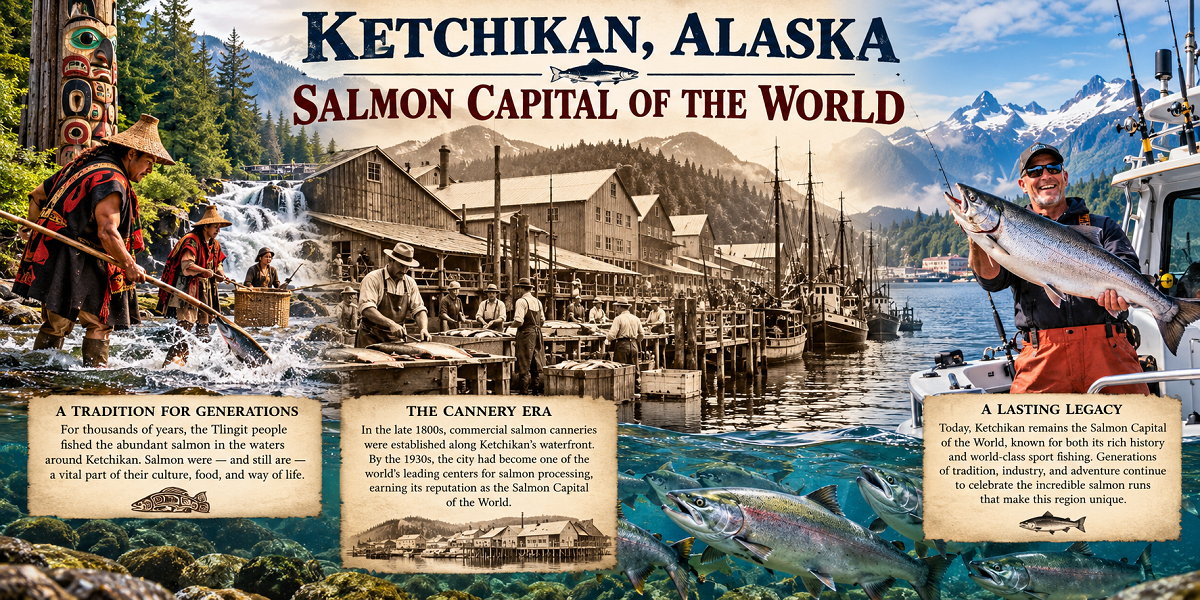
 Long before modern travelers arrived in Southeast Alaska aboard cruise ships and floatplanes, the pristine waters surrounding Revillagigedo Island were renowned for their unprecedented abundance of salmon. Known worldwide as the “Salmon Capital of the World,” Ketchikan’s identity, economy, and heritage have been sculpted by the annual return of five salmon species for centuries.
Understanding Ketchikan’s deep fishing history provides a richer perspective on why these cold, nutrient-rich waters remain the ultimate destination for sportfishing today.
Indigenous Roots: The First Stewards of the Water
Centuries before commercial fisheries emerged, the Tlingit, Haida, and Tsimshian nations established permanent settlements along the sheltered passages of Southeast Alaska. The name Ketchikan originates from the Tlingit word Kitschk-hin, roughly translating to “thundered wings of an eagle” or “the creek near the pierced wing of an eagle.”
For Indigenous peoples, salmon was far more than a food source—it was the foundation of life, culture, and trade:
- Sustainable Harvest: Indigenous communities developed sophisticated fishing methods, including wooden fish traps, intertidal stone weirs, and dip nets, harvesting only what was needed while ensuring robust escapement for future generations.
- Preservation Techniques: Cold-smoking, drying, and salting salmon allowed villages to thrive through harsh winter months and engage in extensive trade networks along the Pacific Northwest coast.
- Cultural Reverence: The annual return of the salmon was celebrated with traditional ceremonies, honoring the spirit of the fish—a deep respect for marine ecosystems that endures in Ketchikan today.
The Industrial Boom: Canneries and Capital Status
The late 19th and early 20th centuries transformed Ketchikan from a quiet fishing village into an industrial power. The arrival of commercial salmon canning in the 1880s sparked a economic revolution in Southeast Alaska.
- The Rise of Canneries: By the early 1900s, dozens of canneries lined the shores of Ketchikan and nearby inlets. Facility lines processed hundreds of thousands of cases of canned King, Pink, Coho, Sockeye, and Chum salmon annually to supply growing global markets.
- Infrastructure & Growth: The demands of the salmon industry built Ketchikan’s waterfront. Wooden boardwalks, docks, and net-loft buildings sprang up along Ketchikan Creek and Thomas Basin, shaping the historic downtown architecture visible today.
- The “Salmon Capital” Title: By the 1930s, Ketchikan was packing more salmon than any other port on Earth, officially earning its moniker as the Salmon Capital of the World.
Evolution to World-Class Sportfishing
As commercial fishing regulations evolved in the mid-to-late 20th century to protect wild stocks, Ketchikan successfully pivoted toward sustainable marine management and world-class sportfishing tourism.
Today, Ketchikan’s pristine channels, deep-water drop-offs, and sheltered passages offer unmatched access to wild Pacific salmon. Guided charter operators continue the town’s proud maritime tradition, bringing visitors from around the globe to experience the adrenaline of hooking into a trophy King or energetic Silver salmon in the very waters that made history.